EFRAIN VIVAS HATTORI
JAPAN . 1991
Born in Tokyo in 1991 to a Japanese mother and a Venezuelan father, Efrain Vivas Hattori was two years old when the family moved to Venezuela. He grew up in Caracas among architects, photographers and artists — closest of all to architecture, through a father who brought him along to the office, where he drew beside him, beside his uncle, the architect Fruto Vivas, and the rest of the team. His eye for the architectural plan was formed there, years before he understood what it would become.
When his parents separated he returned to Tokyo with his mother, at thirteen. He finished school without any pull towards further study, and spent his days skating and writing graffiti — tagging, as he describes it, more as a small act of protest than as a practice. He also picked up the drawing he had loved as a child, and by 2016 had committed to art entirely, with a first exhibition that year.
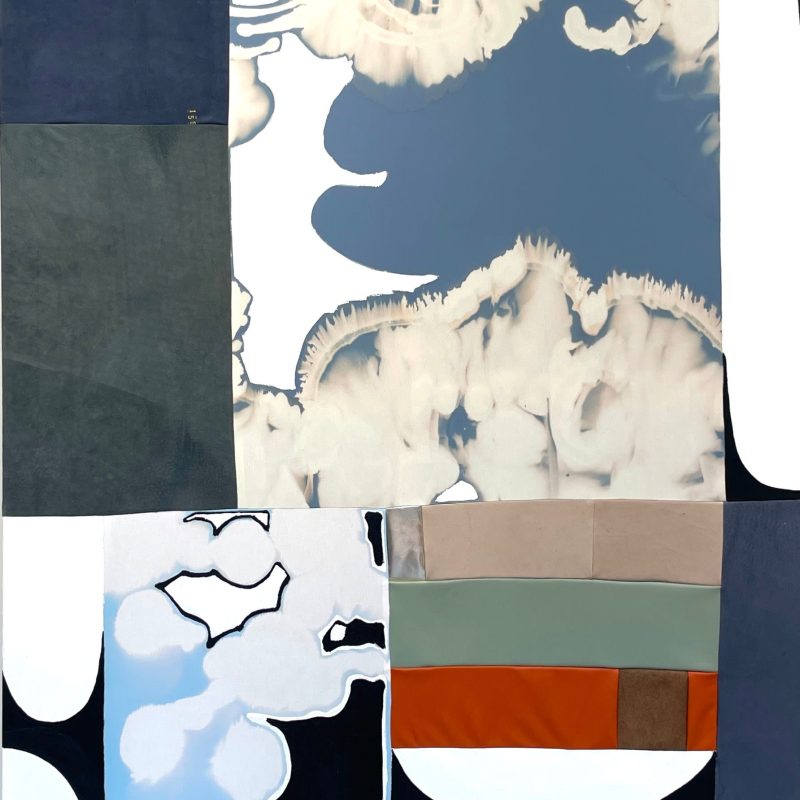
At twenty-five he left Tokyo for Amsterdam, on the reasoning that staying would make his career easier and his work weaker. The move marked him. A bag designer there lent him a studio, a sewing machine and her leather offcuts; he began stretching and sewing leather straight onto canvas, building patchworked surfaces that hold the painting together — or appear to. Back in Tokyo the same instinct returns in cotton and canvas, worked looser and rougher, with spray guns and airbrush.
His palettes shift: bright and bold in one work, earthen in the next, but always cut with shapes and lines in pitch black. The modernism he grew up around remains plainly visible, and combines easily with a streak of surrealism. What emerges reads like a map, though it is never quite clear whether of a city or of a mind.
Alongside painting, he runs Ugoku Estudio, an independent art platform that publishes zines and organises exhibitions and music events. He is also a tattoo artist.
He has exhibited in Amsterdam and Tokyo, including the solo exhibition Luz at Block House Gallery in Harajuku in 2021. Sato Gallery presented his work at Asia Now in Paris in 2020 and, after a residency in the gallery’s space in the summer of 2023, gave him his first solo exhibition with the gallery, Almost Transparent Blue.