
The Story of EXCALIBUR
An artist collective expressing social complexities and challenges through games. November 11, 2024
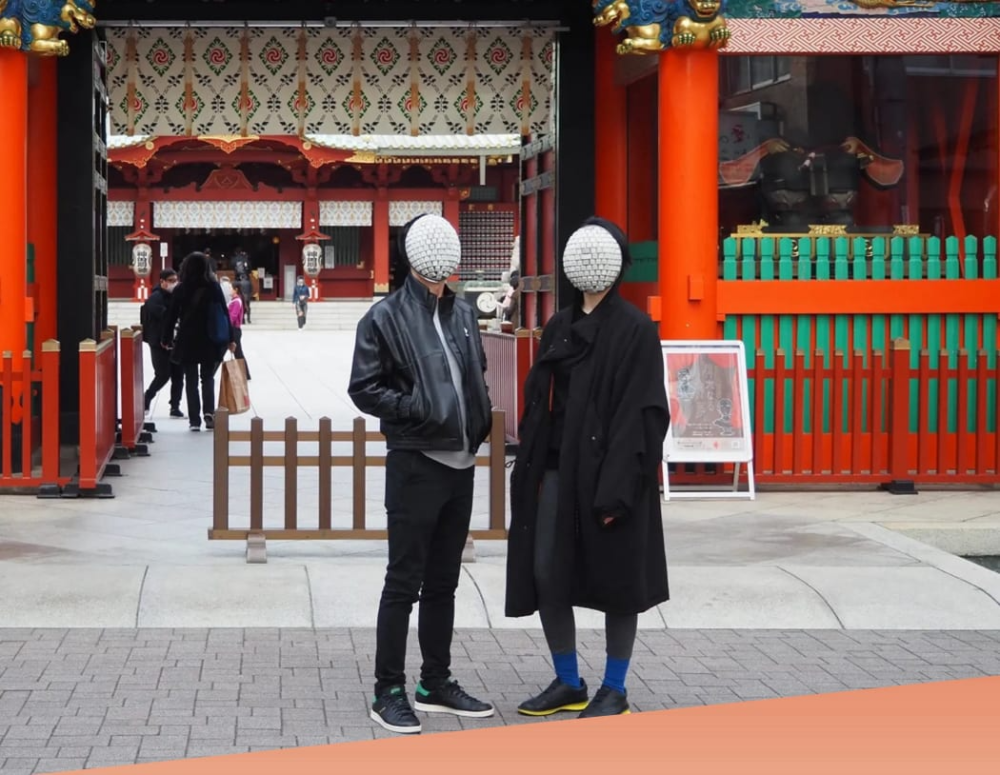
EXCALIBUR, a pioneer of Japanese pixel art, creates works that tell profound stories through what may at first seem like simple video game imagery. After their first solo exhibition, NEW GAME+, in Paris in December 2021, they return for the first time in nearly three years. In 2024, they opened the year with their solo exhibition NEW VOID in Rotterdam in April, followed by creative projects for the Urban Art Fair, and now return to Paris this December with METABIT.
EXCALIBUR is a collective founded by Yoshinori Tanaka. Inspired by the golden-age graphics of 1980s Famicom (Nintendo) games, they create works ranging from paintings and sculptures on Japanese myth and culture to experimental art forms known as Alternate Reality Games (ARG), where everyday life becomes part of the game.
In this interview, artist duo EXCALIBUR — Yoshinori Tanaka and Maiko Iwata — share how they met and joined forces, and look back on what has been an especially eventful year.
Interview: Akiko Naito
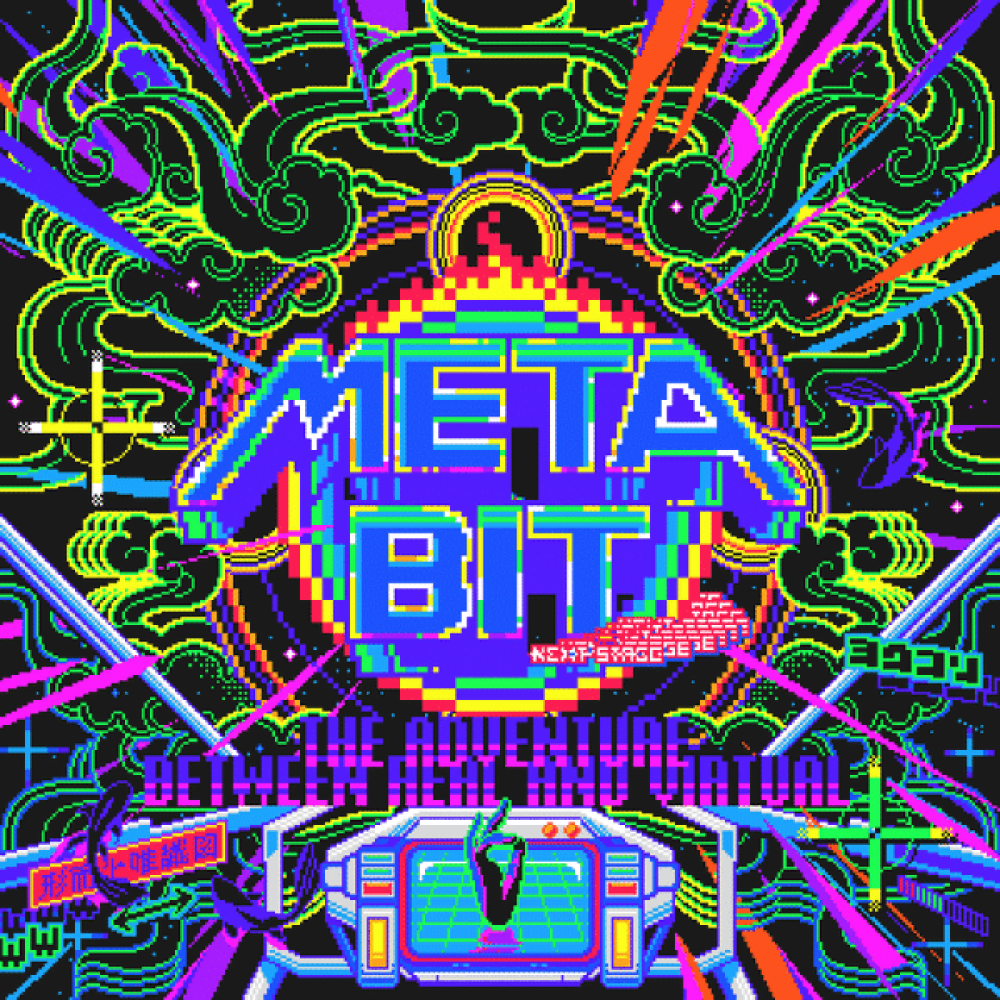
(METABIT, 6–22 December 2024 in Paris.)
Akiko: This year has been eventful, starting with NEW VOID in Rotterdam in April, the UAF, and another exhibition in Paris starting December 6.
Maiko: Yes, this year really has been Sato Gallery’s year.
Akiko: We’ll get into the details shortly, but in our last interview we focused on Yoshinori’s journey. This time, let’s talk about you, Maiko. Yoshinori is from Kyoto, and you’re from Tokyo, is that right?
Maiko: Yes, Yoshinori comes from a region steeped in Kyoto’s mythology, while I grew up near the skyscrapers of Shinjuku. Also, Yoshinori’s father was involved in right-wing activities, while my family leans more to the left. Yoshinori is self-taught in art, whereas I grew up in an art school environment, studying design at art university with teachers like Takashi Murakami. Our backgrounds, upbringings and artistic histories are opposites.
Akiko: So how did you meet?
Yoshinori: I discovered Maiko in 2009, when she was running an art project called GENSO SENTAI LEMONed, an imaginary squad.
Maiko: Actually, I started that in middle school! I was deeply moved by Lemon, a short story by Motojiro Kajii that we read in class, and I started wearing a giant lemon head, painting myself entirely yellow, and parading around town. I didn’t think of it as performance art; it was just something my friends and I did for fun, creating a fictional story around the squad and presenting it at school festivals. But after a close friend passed away, I began presenting it consciously as an artwork.
Yoshinori: Its slogan was “The squad that doesn’t fight.” The paradox of a squad that didn’t fight made me think about the meaning of the project, and I found it intriguing.
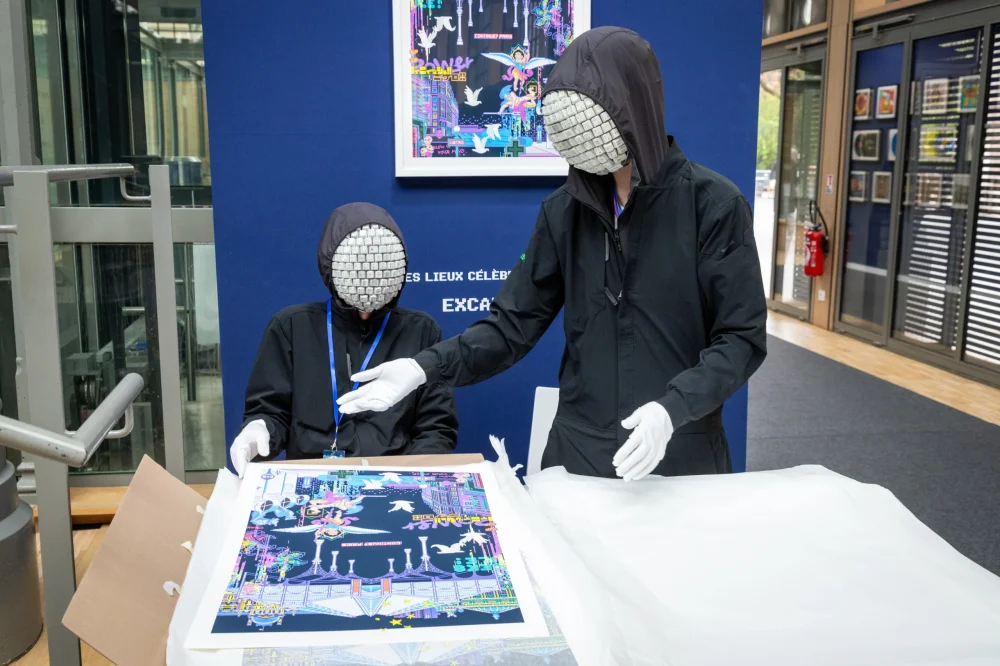
(Maiko and Yoshinori at UAF 2024 — Lionel Belluteau)
Akiko: Is that when you started interacting?
Maiko: I had built an old Japanese house as a “home base” for the GENSO SENTAI LEMONed members and organised a live-action RPG on a remote island. Yoshinori was one of the visitors to these works. We call this method “Alternate Reality Games,” or “gamification,” and he was at my exhibitions from morning to night, passionately talking about the brilliance of the work and why games were necessary for contemporary art (laughs). We’ve been working together under different names for nearly ten years since then.
“I want to be someone’s Excalibur.”
Akiko: What a memorable meeting! So, when did you join EXCALIBUR?
Yoshinori: Maiko joined in 2019, when we took part in Asia Now for the first time with Sato Gallery. Her painting and design skills surpassed mine, so I asked her to join us. We created an incredible piece together, and decided to keep working together.
Maiko: Going back a bit, what made me trust Yoshinori was a combination of his deep understanding of art and games and his entertaining ideas, but the main factor was the experience on that remote island. That island was a depopulated area where people’s true personalities came through. Unlike many artists who behave like the protagonist, Yoshinori would voluntarily do chores no one else wanted to do, like cleaning the toilets and the entrance, without telling anyone. He even found an old sports-day video tape in an abandoned school and spent a week digitising it for the villagers, who still watch it at their summer festivals. That made me think: ‘What an incredible person.’ The concept of EXCALIBUR is also about ‘becoming someone’s sacred sword (Excalibur).’

EXCALIBUR comes from: 1. Final Fantasy’s strongest weapon one can get and a weapon everyone can share. 2. Excalibur is also the sword of King Arthur, making it an international term and one that people of various nationalities can relate to.
Yoshinori: The name EXCALIBUR is inspired by a powerful item from RPGs. I see real life as a game, but I don’t see myself as the main character. So I chose this name hoping to become a useful object that helps others navigate the real world.
Maiko: That experience embodied exactly that. He’s someone who can do unglamorous things for others without announcing it, which I find deeply trustworthy. It’s fascinating that someone like him is involved in contemporary art, and that’s what led us to create art projects and works together.
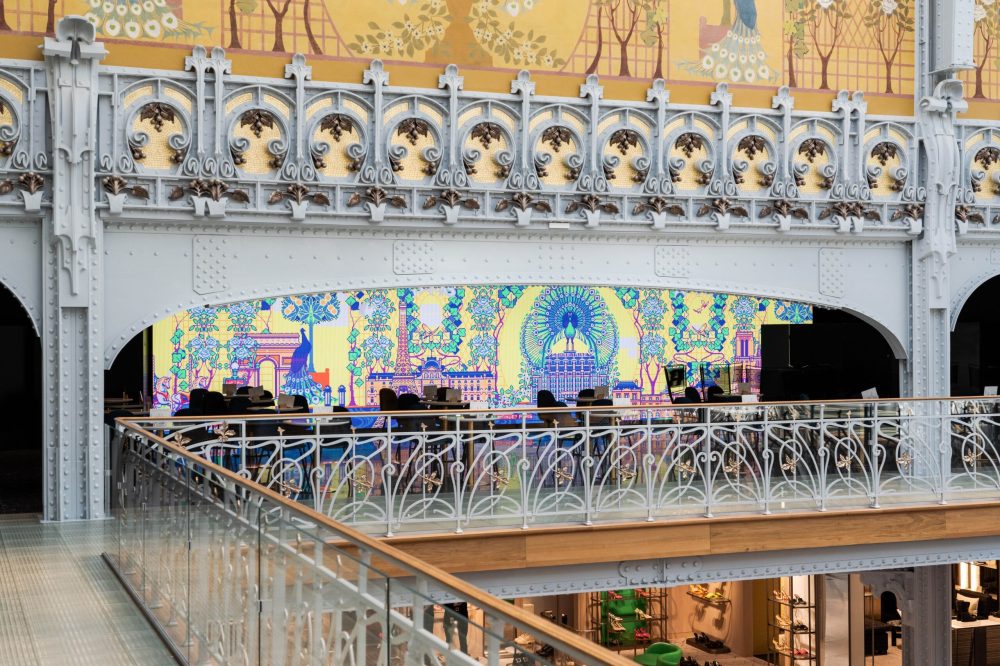
Exhibition at Le Samaritaine, 2022
Akiko: What kinds of projects have you worked on?
Yoshinori: We’ve made a lot of game-inspired art in spaces outside galleries — islands, cities, shopping streets, entire buildings and houses. We focused mainly on conceptual projects and performances.
Maiko: At Sato Gallery, they only handle easily sellable works like paintings, which is unusual within our artistic practice. For us, paintings are part of a space — a clue for understanding the whole work.
Yoshinori: We try to incorporate the mysterious methods we used in cities and on islands into our paintings.
Akiko: How do you divide roles in production?
Maiko: Generally, Yoshinori provides the concept, and I organise or negotiate while refining it with other members. We discuss in particular whether it’s appropriate to present the work as art, depending on the moment and the place. In 2017, we organised a themed wedding-reception exhibition, The Truth Exhibit, around the theme of post-truth. I developed and planned it. Guests wore blindfolds at round tables in a dark room, and kaiseki dishes were served while they couldn’t see. Gradually, more people were allowed to remove their blindfolds, but some guests lied, creating doubt about who to trust. For dessert, everyone had different flavours of what appeared to be vanilla ice cream. On top of that, Yoshinori and I were the biggest liars of all!
Akiko: Wait, really!?
Yoshinori: We only spoke at the beginning, and in the dark, everyone assumed we were there as a couple. No one suspected we weren’t actually together.
Maiko: We even took commemorative photos with the impostors, and people messaged us afterward to thank us (laughs).
Akiko: In April, at the UAF, that was your first time at a European art fair. What were your impressions?
Maiko: We had the opportunity to handle the key visuals for UAF 2024, and we created them during our stay in Paris.
Akiko: Tell us about the theme of the December exhibition.
Yoshinori: The exhibition will present METABIT, a theory of expression that EXCALIBUR has championed since 2010.
Akiko: You’ll be staying in France for a month for this exhibition. What would you like to explore or experience?
Yoshinori: I believe in the power of art to spark personal transformation through other people’s ideas.
Akiko: Finally, why do you make art?
Yoshinori: I want to present something that could serve as a catalyst for change in the world and in society.
Maiko: I’ve always felt a mission to create art, because I love it and because I can.
Maiko: So, we both believe in the power of art (laughs).